Bianca Jamison
The Vampire Prince’s BrideBianca Jamison is introduced as a highly capable woman whose intelligence and education are repeatedly threatened with erasure by other people’s assumptions about her body. Her attempt to secure temporary work at McKenna Enterprises becomes the decisive doorway into the secret life of Eric McKenna, billionaire and Alpha of the New York Pack. Bianca’s importance lies in the way she crosses that doorway unwillingly: she is not recruited into the supernatural world through romance or choice, but exposed to it through violence, fear, and the sudden collapse of the ordinary workplace she thought she was entering.
Identity and Introduction
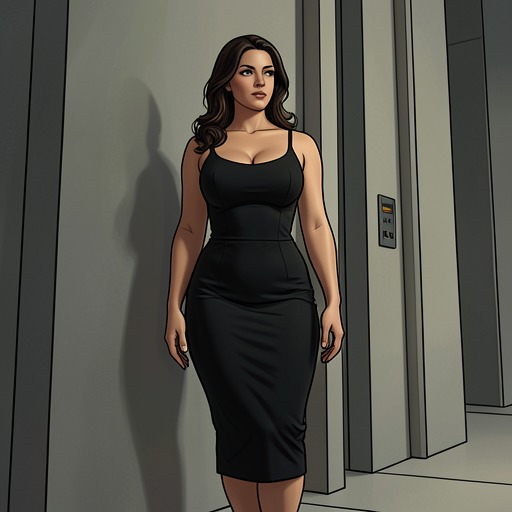
Bianca arrives at McKenna Enterprises desperate to make a good impression at the first interview she has received in three months. At 230 pounds, she expects strangers to notice her weight before they notice anything else, despite having graduated at the top of her class, earned excellent references through several internships, and learned two foreign languages. Her professional clothing and determined attitude are attempts to force the interviewers to see her abilities rather than reduce her to her appearance. The narrative therefore establishes her as academically accomplished and professionally prepared, while also showing the social prejudice that makes those accomplishments difficult for her to display.
Her first approach to the company is almost defeated by circumstance. A traffic jam delays her bus, and she races toward the elevator, knowing that missing it could make her late for the interview. The elevator door begins to close, but a hand stops it in time. Inside is Eric McKenna, whose silent attention makes Bianca feel both aroused and apprehensive. He remains courteous, even gesturing for her to leave the elevator first, but the encounter leaves her unsettled before she knows why. The later revelation that he is a werewolf gives this unease a concrete supernatural meaning without erasing its earlier ambiguity.
The position Bianca obtains is temporary but immediately important. Eric McKenna’s personal assistant has broken her ankle and will be absent for two months, while his secretary, Janet Hutchinson, must take over the assistant’s duties. Bianca is hired to help Janet and accepts despite the short term because a reference from McKenna Enterprises could open future opportunities. Janet explains that Richard McKenna founded the company and ran it until his death the previous fall, after which his three sons began managing it together: Jason in finance, Hector in information technology, and Eric in marketing. Bianca’s new job thus places her inside both a powerful corporation and a family structure whose supernatural significance she does not yet understand.
The Workplace Becomes a Threshold
Bianca’s first day turns from professional initiation to physical danger in the company garage. After Eric discovers a broken neon lightbulb, he tells Janet that they need to leave, but an enormous dark figure tackles him before he can finish. Janet orders Bianca to reach the lobby and alert security, attempting to convert the attack into an emergency that ordinary corporate procedures might contain. That possibility ends when a giant hand covered in dark brown fur seizes Janet and throws her aside with enough force to produce the sound of breaking bones.
Bianca is left face to face with a creature that appears more real than any cinematic monster. Terror immobilizes her; she cannot scream or run, and her mind struggles to process what her eyes show her. Janet nevertheless manages to drive them away from the garage, and Bianca remains in the car, panicked and still trying to escape. The scene makes her a witness rather than a participant: she has no prior knowledge of the pack, no prepared language for the creature, and no meaningful control over the situation. Her ordinary employment has become an encounter with a hidden political and biological order.
The attack is followed by a second reversal. The creature begins to melt and shrink, its golden eyes changing color as its fur thins from a black pelt into human skin. Its clawed hands become the large hands Bianca had noticed in the elevator. Eric then sits where the monster had been, exhausted and naked. The transformation confirms that the threatening figure and the man who had attracted her attention are the same person. Bianca’s fear and attraction are therefore forced into the same frame, making Eric both the source of the danger and the person through whom she must understand it.
Exposure to the Pack
At the Big House, the mansion serving as the Alpha’s home, Eric is met by Brian, his Beta, and the remaining eight members of the Alpha Guard. The Guard’s duty is to protect the Pack, the Alpha, the Alpha’s Mate, and the Alpha’s children, and its members are described as highly trained both individually and collectively. Their disciplined response contrasts with Bianca’s shock and shows that the attack is not an isolated oddity but part of an organized supernatural society with offices, ranks, security, and family obligations.
Eric is given a terrycloth robe while Lieutenants assist Janet and Bianca. Janet remains composed, but Bianca is pale, shivering, and too traumatized to leave the car until Janet helps her out. Eric is especially concerned by Bianca’s condition and recognizes that she has been thrust into the pack’s world without preparation. He orders Janet to take her inside, find her a room, arrange a shower, provide clothing and food, and give her whatever else she needs. This immediate practical care does not undo the violence of the revelation, but it marks a shift in Eric’s conduct from hidden threat to protective responsibility.
When Eric later approaches Bianca’s room, he deliberately makes his body appear nonthreatening, moves slowly, and asks permission to enter. Bianca allows him in but keeps her eyes fixed on him, still nervous and quiet. Her question, “What are you?”, is not a request for a biological explanation so much as an attempt to find a stable name for what has happened. Eric answers that she already knows, while Bianca admits that she cannot bring herself to say it. Her refusal to name him as a werewolf captures the story’s central threshold: knowledge has arrived before acceptance, and the secret has become impossible to keep separate from her personal life.
Social and Thematic Significance
Bianca’s introduction places bodily judgment, labor, and supernatural secrecy in the same narrative structure. She is initially evaluated through conventional workplace expectations and worries that her weight will eclipse her qualifications. Yet the company that offers her employment is also the institutional center of Eric’s power as a billionaire and Alpha. Her labor begins as a temporary administrative arrangement, but it unexpectedly becomes the means by which she enters a hidden community whose hierarchy includes an Alpha, Beta, Lieutenants, and an Alpha Guard.
Her trajectory also contrasts with other forms of coerced exposure in the collection. The wider narrative repeatedly presents bodies as resources controlled by institutions: humans may be recruited as paid blood donors, as in the offer of ten thousand dollars per month plus payment for consumed blood; a human may be kept in a vampire household under the claim that no one is a prisoner; and a fertility shrine may determine kingship through a woman’s pregnancy. The Fifth Cycle Festival goes further, turning a woman chosen as the Goddess into the prize of a lethal male competition, despite the United Species having banned the tradition. Against these systems, Bianca’s story begins with an employment contract rather than a formal supernatural bargain, but the attack shows how quickly a seemingly ordinary arrangement can become an involuntary incorporation into another order.
The collection also sets Bianca’s encounter beside political arguments about rights and protection. Ana Medina helps Senator Seth Fischer prepare a speech opposing the Shifter Registry Act because it could lead to detention and the stripping of shifter rights. Bianca is not a shifter herself, yet her direct exposure to Eric’s hidden identity places her on the other side of that political boundary: she becomes a human who must confront the reality of shifter secrecy and the dangers surrounding it. Her experience gives the abstract debate a personal dimension, because the supernatural is no longer a legislative question or a rumor but a living employer who has protected her after she witnessed his transformation.
Bianca’s decisive narrative function is therefore not simply that of Eric’s potential romantic counterpart. She is the figure through whom the reader enters the New York Pack’s concealed world, and her professional competence prevents her from being reduced to a passive frightened witness. The story first makes her struggle to be seen accurately as a woman with qualifications, then forces her to look at Eric beyond the categories available to her. Her body is judged in the human workplace, Eric’s body is hidden behind a human identity, and the violent garage attack exposes both disguises at once. The result is an introduction built around recognition: Bianca must be recognized for more than her appearance, while Eric must be recognized as both man and werewolf, and the relationship between them can begin only after those concealed identities have entered the open.